Saturday, July 20, 2013

Segrada Familia

On our last day in Barcelona we spent a most enjoyable afternoon in this basilica known as the Sagrada Familia... yet another UNESCO World Heritage site designed by Antoni Gaudi (1852-1926).  

Mr. Gaudi designed several remarkable properties in Barcelona and the closer I examined his work and style the greater was my appreciation of his genius.


We could walk here from our hotel easier than take the Hop On-Hop Off bus... and the ticket lines were much better later in the afternoon... less than 20 minutes.  


Construction commenced in 1882 and in 1883 Gaudi became involved, transforming the project with his creative style.  He devoted his last 15 years totally to this project and when he died in 1926 less than one quarter of this project was complete. 


We read that Gaudi was hit by a street car when crossing the Gran Via in Barcelona and died three days later.  He was 73.


Gaudi was often asked about the extremely long construction time for the church and he replied, "My client is not in a hurry."  


Gaudi knew that he would never see the sanctuary completed in his lifetime. He intended for the cathedral to not only be completed by other architects, but also to incorporate other architectural and artistic styles.


Twins getting photographed by parents at the entrance doors.


Words are used in several places in the design.


Construction passed the mid-point in 2010... and on November 7 that year the church was consecrated with 6,500 in the congregation. 100 priests and 300 bishops were on hand to offer Holy Communion. 

When we walked into this sanctuary we were blown away... totally amazed by the absolute grandeur.  


We went and sat down in the pews to meditate and pray... I didn't want to leave. The organ music helped to mitigate the sounds of a thousand people talking and milling around taking pictures.

The current goal is to have this church totally completed by the 100th centennial of Gaudi's death.  That will take some doing.  There is considerable work in completing all the exterior.  

This central vault reaches 200 feet high.


When these huge columns were made it was all hand work... which was very time and labour intensive. But today in the construction of the remaining towers most of the materials can be prefabricated using computers with CNC technology.  This will help speed things up considerably.


I borrowed this exceptional photo from Wikipedia... and there is more online. Wikipedia has a great photo history of this project and is the source of most details in this blog.
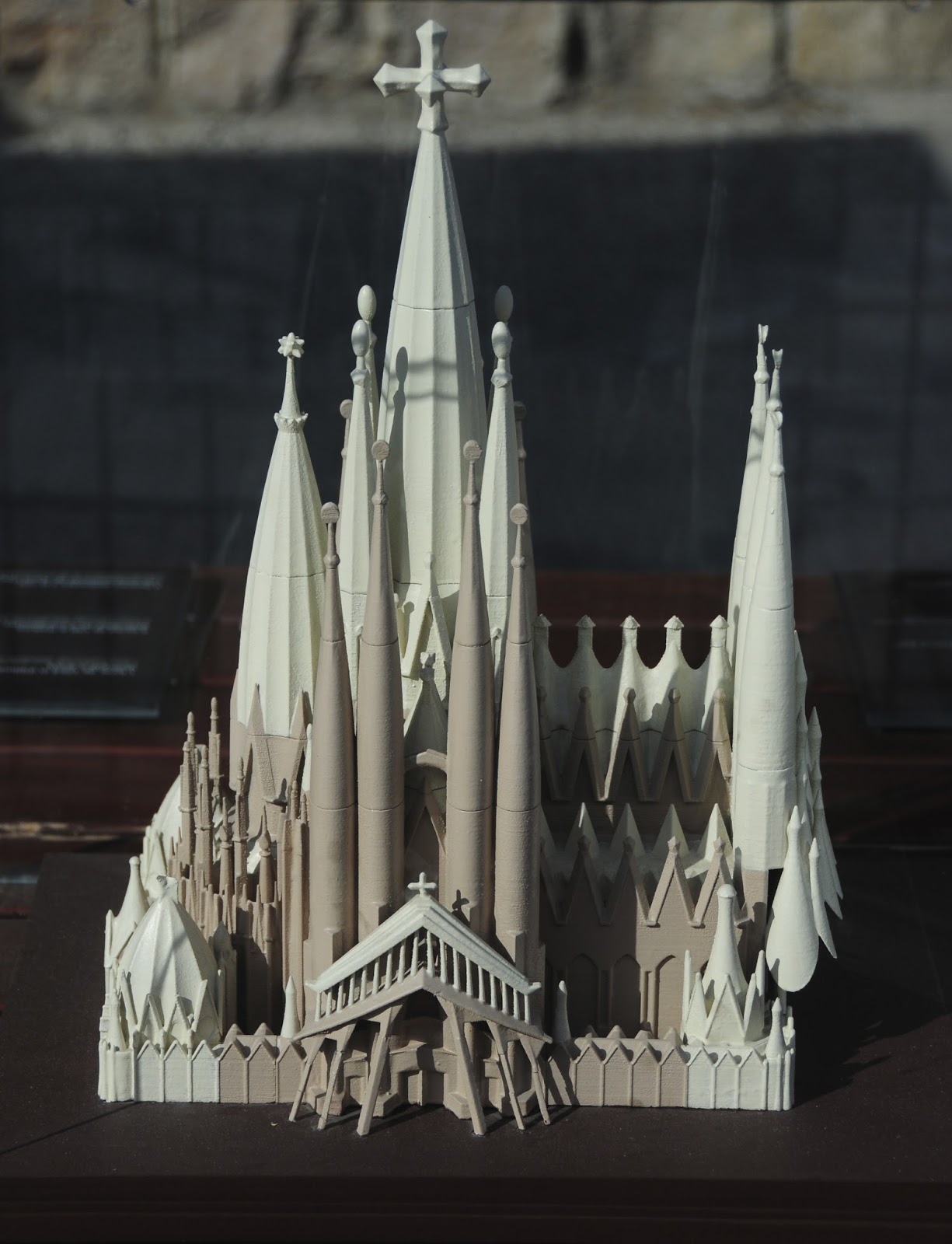

This simplified model shows all the spires... 18 in total.  The tallest represents Jesus Christ, next is the Virgin Mary, then there are the four evangelists and the 12 apostles. 

What ever happened to having a single steeple on the church?  

When finished the Jesus steeple will be 560 feet high, making this the tallest church building in the world.


So far only eight spires have been completed and they correspond with four apostles at the Passion facade.


And four apostles on the Nativity facade.  It is interesting how the character of these two facades is totally different.


Constructed between 1894 and 1930 this Nativity Facade was the first facade to be completed... so Gaudi was still alive when most of this was done, or at least commissioned.


This facade was dedicated to the birth of Jesus... and here Joseph with Mary on a donkey are travelling to Bethlehem.


The three wise men came bearing gifts for the Christ child.  The sculptures just go on and on.


Gaudi loved nature and included many scenes with birds and animals... full of symbolism. 


For instance, the three porticos are separated by two large columns, and at the base of each lies a turtle... one representing the land, the other the sea.  The turtles are symbols of time... made in stone, unchangeable. 


On the passion facade the style of the characters is quite different... more plain and simple.  Construction on this facade began in 1954.  


See the rooster lower left... Jesus told Peter his faithfulness would be tested... that he would deny even knowing Jesus that night... before dawn when the rooster would crow three times.

Notice the totally different style of figures.


The flowers and details on the top of the spires are all different.  This is not prefabbed.  Some tile man climbed up about 400 feet of scaffolding... or had to ride in a crane basket to go to work on this. How would you like to have this job on your resume?


This 4.44 minute video of the tops of the spires is amazing.  It is just a clip out of a longer documentary on Barcelona.  No words... just photos from a helicopter and music...five minutes well spent.  


The side nave vaults reach 30 metres (100 feet high).


There are both stairs and an elevator that one can take to ascend into the spires and get a view of the city of Barcelona. We look forward to doing that next time we come here. 

There is so much to see in this place, you can't see it all in just one visit.


Organ pipes in background with alter above.


Hand holding without even a monopod makes this kind of telephoto shot hard to capture.


The beauty of the windows is reflected off the pipes of the organ, which was installed in 2010. It has 1492 pipes, 26 stops, two manuals and a pedalboard.


 Because of the vast size of this sanctuary, they plan to add several additional organs with up to 8,000 pipes, which can either be played individually or all together from a single console. 


In doing research on Segrada Familia I stumbled on a local Barcelona photographer with exceptional photos of Guadi architecture. Just click on this link to see more of Clement Celma's work. Best viewed on full screen.

Just for fun check out Celma's interactive 360 panorama's... like this one of Santa Maria Del Mar in Barcelona... or Torre Agbar... that bullet shape building downtown.  Use your arrow keys to move around... use shift to zoom in.  Very cool site.

"God is in the details." 
-Ludwig Mies van der Rohe

Shirley and I pooled our best photos for this blog.

Thursday, July 18, 2013

The Tunnel Trail -Hope BC

For several years I have known about this hiking trail just east of Hope.


This trail follows a part of old Kettle Valley Railway that connected the Thompson Okanagan to Vancouver.  Parts of the Railway service was discontinued after 1961 until the late 1980's when it was totally abandoned.


The route went through some of the most stunning and picturesque scenery, requiring 13 tunnels and 43 bridges.  It was a very difficult and expensive section of railroad to build, but with great difficulty comes extraordinary beauty.


Much of the abandoned railroad has been striped of the tracks and ties to make fantastic hiking trails.  If we had known we would have had our picnic lunch here instead of at the trail head parking lot.


There were a lot of people enjoying this walking trail today.


Within about 20-25 minutes we had walked thru three tunnels.  You can see in the photo above the end of the first tunnel... then thru the second tunnel you can see the third tunnel.


A couple guys on bikes probably went to the end of this trail... about 8 km.


Looking over the handrail of the bridge the rushing Coquihalla River made a lot of noise!  It was quite thrilling.


Only the third tunnel was partly encased in concrete.


The last bridge after the third tunnel was wider... and not the original trestle. 


We took photos of each other and then turned around to go back.


Most of the trail and tunnels had the river very close nearby.


In the longest tunnel a young boy was shining his flashlight to help his grandmother see the way.  It was pretty dark.


As we got close to the parking lot Shirley is text messaging. 

It was a wonderful, little pleasant hike with great views.  Next time we hope to go further, but today we spent just over 90 minutes here in total for a picnic, a walk and a lot of iPhone photos.

Monday, July 15, 2013

My Ten Suggestions


This morning I woke up early and went for a great walk.  When I walk by myself I often multitask and pray for a while.  It was on the walk I decided I would make a list of 10 things I might try to do every day.


I also decided to start a notebook to keep track of all the new ideas and lists.  So here goes.  Here is my first list.


My Ten Suggestions to Have a Happy, Healthy and More Productive Life

After I wake up every day I would like to:

1.  Go for a walk.

2.  Pray on the way.

3.  Read something that inspires me.

4.  Write list of 3 new creative ideas of things I might like to do (if money were no object)

5.  Get dressed... look like I care.

6.  Eat breakfast like a king, lunch like prince and dinner like a pauper.

7.  Get to my desk before 6:30 AM. (before the market opens in NYC.)

8.  Look at my To Do List and do the most important thing first.

9.  Write a note/email or make a call and surprise someone out of the blue.

10.  Make a list of three or more "must do" things for tomorrow before I go to bed.

This is by no means a list to end all lists... but it is a list that is doable for me and I think will help me to be more happy, healthy and productive.

Now try your hand at it and make up your list of 10 things that will make your life better.

"It's not what we do once in a while that shapes our lives.  It's what we do consistently." 
-Anthony Robbins


Saturday, July 13, 2013

Up Close in Casa Batllo

Going thru this amazing house was an inspiration to our creativity. Shirley did such an excellent story blog post earlier this week... if you haven't seen it yet just click on this link.


In this blog I want to build on the foundation of Shirley's blog post with a few more close up photos of things we found interesting.


Stained glass above living room window... cool colours.


This pattern on a column was used in different colours throughout the house.


You can see the subtle pattern on the ceiling... as well as the wall below.

How did Gaudi do this boob detail?  I have no idea.  Maybe he had a giant ice-cream scoop to put the stucco onto the ceiling.


Wall light.


Ceiling lights.


 Different designs were used in different places and all were different.


And what is this?  Would you believe it's a hallway near the top floor... and one of the lights must be burned out making one of the ribs dark.  I like the feeling of it.

Sometimes photos and paintings are more interesting when you don't see the whole thing and the viewer has to use their imagination to complete the story.


Glass mixed with ceramic in this mosaic.


Mosaic wall designed with plant niches... currently not used for plants.


Ceramic tile pattern on large garden patio.


This patio with skylights in the floor... obviously there's a room below. Likely a mechanical room.


Handrail on part of rooftop patio...


Thru this hole in the handrail we see mostly the neighbours patios'... however in the bottom thru the grille you can see the arched mosaic planter wall already shown three photos back.


Roof ridge... or maybe parapet detail.


“His houses are for erotomaniacs, where you can dream as well as live.” -Salvador Dali 


Of course at the end of every tour there is a gift shop where you can leave a little more money and take a memory book or gift for someone.  There are more books on Gaudi than this photo shows... and available in almost any language.


This little salamander is Gaudi's trademark.  Isn't he precious?  Ask me how many times I have kicked myself for not buying it?

Now would be a good time to end this blog... but I have one more fun detail that isn't Gaudi which I captured with the camera.


This photo taken from the street shows an camera arm centre top.


Not to miss any opportunity to make another few dollars off the tourists, when you are touring Casa Batllo you can have your picture taken with your spouse/friend standing on the upper deck of this house.  That will be 15 euros please.  Sorry.  We didn't get one to show you.

Hope you are having a good weekend, where ever you are... what ever you are doing.


“The measure of a man's culture is the measure of his appreciation. We are ourselves what we appreciate and no more.” 
-Frank Lloyd Wright